
At the Farnborough International Airshow on July 20, 2026, Archer Aviation unveiled Thunder, an autonomous attack rotorcraft built jointly with defense-tech company Anduril. The stock jumped nearly 20% on the news. It’s a strange headline for a company whose entire public identity has been built around flying taxis quiet, all-electric aircraft that ferry passengers over city traffic. Archer hasn’t sold a single one of those to a paying passenger yet. It just became, at least partly, a defense contractor instead.
That’s not a contradiction so much as a company managing the gap between the business it’s building and the business it can actually get paid for right now.
A Company Still Waiting on Its Core Product
Archer’s civilian aircraft, Midnight, has spent years working through FAA certification. The company received full acceptance of its “Means of Compliance” earlier this year, a genuine milestone, and reportedly a first for any eVTOL (electric vertical takeoff and landing aircraft) but it’s still moving through Phase 4 of the FAA’s Type Certification process, with commercial passenger flights targeted for later in 2026 at the earliest. CEO Adam Goldstein has kept the company’s public goal fixed on flying air taxis at the 2028 Los Angeles Olympics, a target he’s openly called “ambitious” even while reaffirming it.
In the meantime, Archer is spending, not earning. It ended 2025 with roughly $2 billion in liquidity and no meaningful trailing profit. A position that gives it runway, but not revenue. That’s the condition Thunder was built into: a way to generate real, paying demand years before the passenger business can legally carry its first customer.
The delay isn’t really Archer’s alone. Certifying an entirely new category of passenger aircraft was always going to take longer than most software-driven industries are used to, and court battles over airspace rules and safety standards have slowed the US eVTOL sector’s commercial timeline more broadly. That’s useful context for reading Thunder correctly: it isn’t a sign that Archer’s civilian ambitions stalled specifically, so much as a company recognizing that an entire regulatory category was always going to move on its own schedule, and building a second business that doesn’t have to wait for it.
New Market Existing Capability
The classic way to think about a move like this is the Ansoff Matrix, which sorts growth strategy into four boxes based on whether you’re selling an existing or new product into an existing or new market. Archer wasn’t just adding a feature to Midnight, it built an entirely different aircraft, Thunder, aimed at an entirely different customer: defense buyers rather than city commuters. That’s diversification, the riskiest box on the matrix, but a specific and more defensible version of it. Archer isn’t diversifying into something unrelated to what it knows, it’s taking the same core competency (electric vertical-lift propulsion, flight control software, rapid aircraft design and manufacturing) and pointing it at a market with a fundamentally different, and faster, path to revenue.
That difference in path is the entire point. Civilian passengers need years of regulatory certification before a company can legally sell them a ticket. Defense customers evaluate capability, run procurement processes, and can sign contracts on a completely different timeline, one that doesn’t require convincing millions of individual consumers to trust a new form of transportation before the first dollar comes in.
Same Airframe, Two Very Different Businesses
The deeper logic here is a dual-use platform strategy: one core piece of engineering, sold into two markets that have almost nothing in common except the underlying technology. Thunder and Midnight likely share meaningful portions of their propulsion, battery, and autonomy architecture, which means every dollar spent developing one platform partially de-risks the other. That’s an efficient way to spread genuinely enormous R&D costs like building a certified aircraft from scratch is not cheap, across two demand curves instead of betting everything on one.
It’s also a strategy with a real tension built into it. Archer’s brand has been built around safety, trust, and a friendly public image, that being an aircraft for families and commuters. Anduril’s identity is built around autonomous weapons systems designed to multiply combat power. Housing both under variations of the same platform is efficient from an engineering and balance-sheet standpoint; whether it’s equally clean from a brand standpoint, especially as Archer tries to build public trust in a passenger product, is a genuinely open question the company hasn’t had to answer yet, because Thunder’s commercial customers haven’t been named.
Where eVTOL Actually Sits on the Adoption Curve
It’s worth stepping back to ask why “first commercial customers” is still the headline this many years into the eVTOL industry’s existence. Rogers’ diffusion of innovation model describes how new technologies move through a population with innovators first, then early adopters, then the early and late majority, each stage requiring the one before it to build enough trust and infrastructure. Geoffrey Moore’s later refinement of that idea added a useful warning: there’s a “chasm” between early adopters and the mainstream majority, and plenty of promising technologies die trying to cross it because the qualities that excite early enthusiasts (novelty, ambition, being first) aren’t the qualities that convince a cautious mainstream buyer (reliability, track record, price parity with the status quo). By that framework, commercial eVTOL as a category is still pre-chasm: there is no meaningful passenger revenue anywhere in the sector, years after the leading players went public.
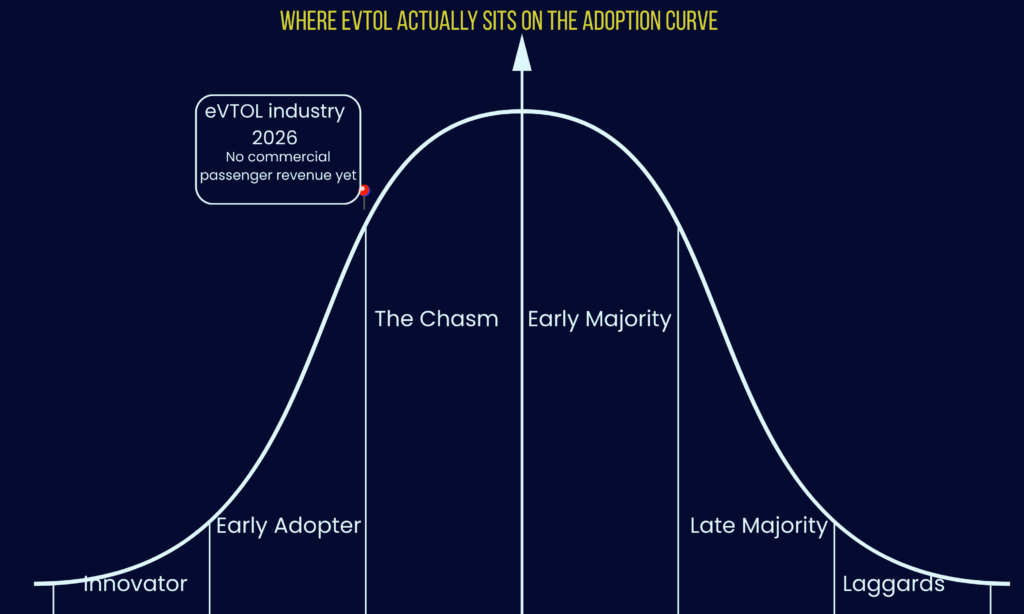
The rest of the field underscores the point. Joby Aviation’s stock is down 45% year-to-date; EHang’s is down 62%, with deliveries falling from 66 units in the fourth quarter of 2025 to just four in the first quarter of 2026. None of the major eVTOL companies are profitable on a trailing basis, and none carry a meaningful P/E ratio, because there isn’t enough revenue yet to make that math meaningful. Archer’s 20% pop on the Thunder news wasn’t the market pricing in a civilian air taxi breakthrough, it was the market rewarding the one eVTOL player that found a way to generate near-term revenue outside the industry’s stalled adoption curve altogether.
The Ground Floor Take
Thunder buys Archer something the rest of the eVTOL field doesn’t have yet: a plausible revenue story that doesn’t depend on regulators, city governments, and millions of first-time passengers all moving at once. That’s a real strategic advantage, and the market reaction reflects it. But the near-term marker to actually watch isn’t the unveiling, it’s whether the “first commercial customers” Archer promised to name this week show up with firm order economics attached, or read closer to letters of intent, the kind of soft commitment that generates headlines without generating cash.
The larger question underneath all of it is one Archer shares with a lot of frontier-technology companies right now: how much of the story is the technology, and how much is the capital that keeps showing up ahead of the revenue. Archer isn’t SpaceX, it’s nowhere near that scale but the pattern of a not-yet-profitable, story-driven public company leaning on a second, faster-moving business line to buy time for its harder, slower-moving one is a familiar shape this year. Whether Thunder turns out to be a smart hedge or the business Archer actually becomes may depend less on engineering than on how patient its shareholders are willing to be with Midnight in the meantime.


Pingback: Blue Origin Valuation: Why Investors Paid 175x Revenue - Ground Floor Analyst