
For six decades, Warren Buffett was one of the most reliable forces in investing. From 1965 to 2024, Berkshire Hathaway compounded at approximately 19.9% annually nearly double the S&P 500’s 10.4% over the same stretch. Betting against Berkshire was, as one analyst put it, “roughly as smart as bringing a knife to a gunfight.”
Then Buffett retired.
Since his retirement announcement in May 2025, Berkshire Hathaway shares have lagged the S&P 500 by roughly 30 to 41 percentage points. The S&P 500 has gained between 25% and 31% over that period. Berkshire, meanwhile, has been approximately flat or down single digits. In 2026 alone, Berkshire’s B shares are down roughly 4% while the broader index has gained nearly 10%.
The question that investors, analysts and business students worldwide are asking is deceptively simple: Is this a temporary blip in one of history’s greatest investment stories or the beginning of a permanent decline?
What Actually Happened The Facts First
Before we analyse, let’s understand what changed.
Warren Buffett officially stepped down as CEO of Berkshire Hathaway on December 31, 2025, handing the reins to Greg Abel, who had served as Vice Chair overseeing non-insurance operations. Buffett, now 95, remains board chair and continues coming to Omaha headquarters but has stated he will “go quiet” and leave all decision-making to Abel.
Abel inherited a remarkable but complicated legacy. Berkshire’s portfolio worth approximately $381 billion has more than 65% concentrated in just six stocks. Its cash and equivalents hit a record $397 billion by mid-2026. The company sits on what may be the most conservative balance sheet in corporate America and that conservatism, which served Buffett brilliantly over decades, is now at the heart of the underperformance debate.
The numbers are stark. While AI-driven tech stocks powered the S&P 500 to record highs in April and May 2026, Berkshire fell nearly 11% over the same two months. The gap between Berkshire and the index widened to its largest point in years.
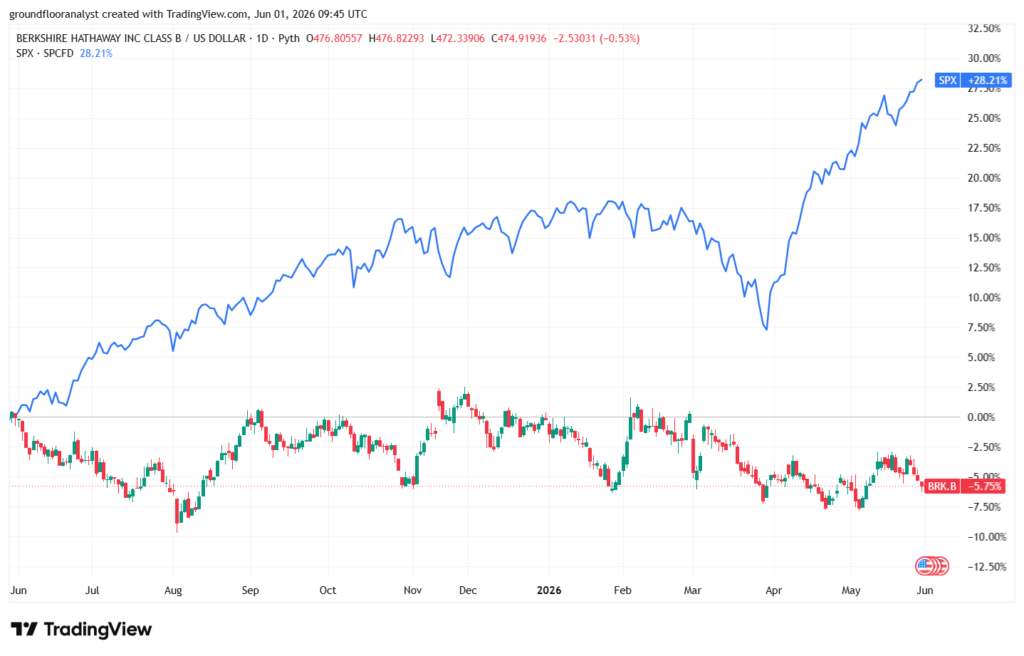
BRK.B vs S&P 500 — > 1 Year Performance. Source: TradingView. Click Trading view comparision to view the live chart.
The Value Investing Framework, Has the World Changed?
To understand Berkshire’s predicament, you need to understand the philosophy that built it.
Value investing the discipline Buffett inherited from Benjamin Graham and perfected over six decades. It is built on a simple premise: find companies trading below their intrinsic value, buy them with a margin of safety, and hold for the long term. The approach rewards patience, discipline and the ability to ignore short-term market noise.
For most of Buffett’s career, this framework was a superpower. He identified undervalued businesses like Coca-Cola, American Express, GEICO before the market recognized their true worth, and held them as they compounded over decades.
But the current market environment poses a genuine challenge to traditional value investing. The stocks driving S&P 500 returns in 2026 are Nvidia, Microsoft, Meta, and Apple, which are not cheap by any conventional valuation metric. They trade at elevated price-to-earnings multiples that a traditional value investor would find difficult to justify. Yet they keep delivering extraordinary returns because their competitive moats are built on AI infrastructure, network effects and platform dominance which are genuinely unlike anything value investors encountered in the 20th century.
Buffett himself acknowledged this evolution. His massive position in Apple, a technology company he initially resisted showed he could adapt. But the broader Berkshire portfolio remains tilted toward what analysts call “old economy” businesses: railroads, insurance, energy and consumer staples. These are excellent businesses. They are not, however, the businesses the current market is rewarding.
Porter’s Five Forces — Why Berkshire’s Core Holdings Face Structural Pressure
A Porter’s Five Forces analysis of Berkshire’s key holdings reveals why the portfolio is struggling in the current environment.
BNSF Railway (railroads): Faces increasing competitive pressure from trucking, which has benefited from route optimization technology. The threat of substitutes like electric trucks, autonomous logistics is growing. Bargaining power of customers is rising as alternatives improve.
Berkshire Hathaway Energy: Renewable energy disruption is reshaping the utilities landscape. Traditional energy assets face regulatory pressure and stranded asset risk. New entrants in solar and wind are compressing margins across the sector.
Insurance (GEICO): Competitive rivalry in insurance has intensified dramatically, with tech-driven insurers like Lemonade using AI to underwrite faster and cheaper. GEICO has faced underwriting losses in recent years as claims costs rose faster than premium adjustments.
Consumer brands (Kraft Heinz): Faces intense competitive rivalry from private label products, changing consumer preferences toward healthier options, and rising input costs. Kraft Heinz has been one of Berkshire’s most painful investments.
The pattern is clear: many of Berkshire’s core holdings occupy industries where competitive forces are intensifying, substitutes are emerging, and the structural advantages that made these businesses so attractive in the 1980s and 1990s are gradually eroding.
The $397 Billion Question — Cash as Strength or Drag?
Perhaps the most debated aspect of Berkshire’s current situation is its extraordinary cash pile.
$397 billion in cash and equivalents is not a number that fits easily into conventional corporate finance thinking. At current T-bill yields, that cash is generating meaningful returns but it is not generating the returns that equities delivered during the market’s 2026 rally.
Bulls argue this cash pile is a fortress protection against a market correction that Buffett, with his historical perspective, may believe is coming. The late 1990s dot-com bubble is a relevant precedent: Berkshire underperformed significantly as tech stocks soared, then its conservative positioning looked prescient when the bubble burst in 2000-2001.
Bears argue the cash is a drag that reflects an inability to find attractive investments at scale. Berkshire’s sheer size, now a trillion-dollar enterprise makes transformative acquisitions nearly impossible. The universe of deals large enough to move the needle for Berkshire has shrunk dramatically. As Buffett himself cautioned shareholders as long ago as 2023, Berkshire’s size and composition make dramatic outperformance “increasingly difficult.”
From a capital allocation perspective, sitting on $397 billion while the market rallies 30% is an opportunity cost that is difficult to defend in the short term whatever the long-term rationale.
The Leadership Transition, Is This More Than Just a CEO Change
What is often underappreciated in the Berkshire story is that Buffett’s departure is not simply a management transition. It is the removal of an irreplaceable competitive advantage.
Buffett was not just Berkshire’s CEO, he was its brand, its investment thesis, its risk management framework and its deal-making engine, all rolled into one 95-year-old person. For decades, Berkshire attracted investment opportunities that no other company could access, precisely because of Buffett’s reputation. CEOs called Buffett personally when they wanted a white knight investor. Boards accepted below-market terms because Buffett’s endorsement was worth more than the discount.
Greg Abel is, by all accounts, an exceptional executive. He built Berkshire Hathaway Energy into a major operation and is deeply respected within the company. But he is not Warren Buffett. The intangible advantages that came with Buffett’s name, relationships and six-decade track record cannot be transferred to a successor however capable.
This is what organizational behavior scholars call the “key person risk” problem, magnified to an almost unprecedented scale. Berkshire built its competitive moat partly around an individual rather than purely around systems and processes. When that individual steps back, part of the moat goes with him.
The Counterargument
A balanced analysis demands we take the bull case seriously too.
History offers a compelling parallel. In the late 1990s, Buffett was widely criticized for missing the dot-com boom. Magazine covers questioned whether he had “lost his touch.” Then the Nasdaq fell 78% and Berkshire’s conservative positioning looked like genius.
Could we be in a similar moment today? AI stocks are trading at extraordinary valuations. The S&P 500’s gains are heavily concentrated in a small number of mega-cap technology companies. If the AI investment cycle disappoints, if the promised productivity gains take longer to materialize than the market expects then the defensive, cash-rich positioning of Berkshire could prove prescient.
The $397 billion cash pile also represents extraordinary optionality. In a market downturn, Berkshire could deploy capital at distressed prices the way Buffett did during the 2008 financial crisis, extracting highly favorable terms from companies desperate for liquidity. That kind of countercyclical positioning is where Berkshire has historically created its greatest value.
Greg Abel, for his part, has signaled a willingness to be more active resuming buybacks in March 2026 for the first time since 2024, and indicating a desire to deploy the cash pile when the right opportunities emerge.
The Ground Floor Take
Berkshire Hathaway’s underperformance in 2026 is real, significant, and worth taking seriously. It reflects genuine structural challenges: a portfolio tilted away from the sectors driving market returns, a cash pile that has become a drag in a bull market, and the irreplaceable loss of Warren Buffett as the company’s central competitive advantage.
But it does not necessarily mean the story is over. Berkshire remains one of the most financially sound enterprises on the planet. Its insurance float, its diversified business portfolio, and its $397 billion in dry powder give it resilience and optionality that most companies can only dream of.
The deeper question is one that neither bulls nor bears can answer with certainty that is whether the world has changed in ways that permanently disadvantage Berkshire’s approach, or whether the current underperformance is simply the latest chapter in a story of patient capital waiting for its moment.
Buffett himself built his fortune by being right when markets thought he was wrong. Greg Abel now faces the challenge of doing the same but without the six decades of credibility that made Buffett’s contrarianism so compelling.
Is Berkshire losing its magic, or is it simply waiting for the market to come back to it?
The answer may depend entirely on what happens next in the AI boom and whether history decides to rhyme.


Pingback: SpaceX Goes Public: The Numbers Behind History's Biggest IPO - Ground Floor Analyst