On June 4, 2026, the Nasdaq fell 4.18% but what does this AI sell-off really mean for traditional industries like manufacturing, healthcare and finance? What are the AI’s impact on the traditional businesses? Nvidia, AMD, Broadcom and the rest of the AI chip ecosystem lost hundreds of billions in market capitalization in a matter of days. Financial headlines screamed about the “AI crash” and panicked investors rotated out of technology stocks at record speed.
But here is the question most headlines missed entirely: what does a stock market sell-off in AI actually mean for a hospital in Ohio, a factory in Stuttgart, or a bank in Singapore that has been quietly building AI into its operations? The answer is more nuanced and more important than the market hysteria suggests.
What Actually Happened And What Didn’t
Before we analyse the business implications, let’s be precise about what the sell-off was and wasn’t.
The immediate trigger was Broadcom’s Q2 2026 earnings, strong by any conventional measure, with revenue up 48% year-over-year and AI chip revenue growing 143%. But Broadcom failed to raise its forward AI chip guidance, and markets priced for perfection punished the entire sector. A stronger-than-expected jobs report pushed Treasury yields higher, making the future cash flows that justify high-multiple AI stocks worth less in present value terms. The result was a violent, concentrated sell-off that wiped out months of gains in days.
What this was: a valuation correction in publicly traded AI infrastructure stocks, driven by a combination of guidance disappointment, macro factors, and profit-taking after an extraordinary run.
What this wasn’t: evidence that AI doesn’t work, that companies are abandoning AI investment, or that the productivity gains from AI in traditional industries are somehow reversed.
These are very different things. And confusing them could lead traditional businesses to make a costly strategic error in either direction.
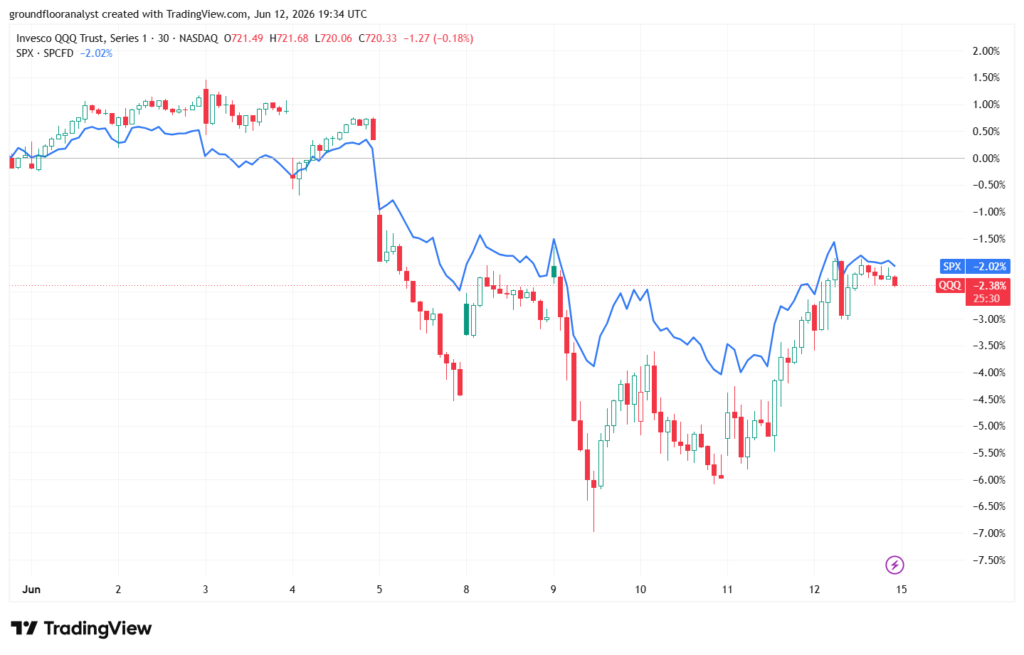
Nasdaq 100 (QQQ) – The June 4, 2026 sell-off. Source: TradingView
McKinsey’s Three Horizons
Before diving into specific industries, it helps to have a clear mental model for categorising AI investments. McKinsey’s Three Horizons of Growth offers exactly that.
Horizon 1 covers investments that defend and extend the core business, things that are already working and need to be protected. In AI terms, this means automating existing processes, reducing costs, improving efficiency. Predictive maintenance in a factory. Fraud detection in a bank. Clinical documentation in a hospital. The ROI is near-term, measurable, and relatively certain.
Horizon 2 covers investments that build emerging opportunities and new capabilities that could become significant revenue drivers in three to five years. AI-powered customer personalization, intelligent supply chain optimization, and AI-assisted diagnostics fall here. Higher uncertainty, longer payback periods, but still grounded in existing business models.
Horizon 3 covers genuinely transformative bets, investments in businesses or capabilities that don’t yet exist but could define the company’s future like Orbital AI compute, Fully autonomous manufacturing, AI replacing human financial advisors entirely. The highest uncertainty, the longest time horizons, and the greatest potential upside.
The sell-off changes the calculus differently depending on which horizon you are investing in. Horizon 1 AI investments are largely immune to stock market volatility, their ROI is operational, not financial. Horizon 3 investments deserve more scrutiny when capital markets tighten and the cost of uncertainty rises.
The TCO Reality
One of the most underappreciated aspects of AI adoption in traditional industries is the Total Cost of Ownership the true, fully-loaded cost of deploying and sustaining an AI system over its useful life.
Most AI investment discussions focus on the upfront licensing or development cost. The TCO framework demands a more complete accounting:
Direct costs include software licensing, hardware infrastructure, cloud compute, and implementation fees. These are visible and usually well-estimated.
Indirect costs include the time and productivity lost during implementation, the cost of retraining staff, the management bandwidth consumed by the transition, and the opportunity cost of IT teams diverted from other projects. These are frequently underestimated by 30-50% in enterprise AI projects.
Ongoing operational costs include model maintenance and retraining as data drifts, security and compliance monitoring, vendor support contracts, and the cost of managing edge cases that automated systems cannot handle. These costs tend to grow over time and are rarely budgeted adequately in year one.
Hidden costs are the most dangerous: the cost of failed implementations, the reputational and regulatory risk of AI errors in high-stakes domains like healthcare and finance, and the organizational disruption of change management at scale.
Understanding the full TCO changes the ROI calculation significantly. A system that looks attractive at a 12-month payback period on direct costs alone may look very different when indirect and operational costs are included. This is particularly important now, because the sell-off has pushed AI vendor prices lower but lower acquisition costs do not necessarily mean lower TCO.
Operations Under a New Light
Manufacturing was already the most cautious of the three major traditional industries when it comes to AI adoption. Oxford Economics data shows manufacturing spends just $672 per employee on AI in 2026 compared to $3,470 in professional services and $2,200 in finance. Yet AI spending in manufacturing grew 48% year-over-year, primarily concentrated in predictive maintenance and quality control.
From a supply chain and operations perspective, the sell-off creates a specific decision point around the Three Horizons framework.
Horizon 1 manufacturing AI like predictive maintenance, quality control, and demand forecasting has clear and proven ROI. These systems pay back within 12 to 18 months in most deployments and the business case is unaffected by what Nvidia’s stock is doing. A factory that reduces unplanned downtime by 25% through AI-powered predictive maintenance saves real money regardless of market conditions.
Horizon 2 manufacturing AI like intelligent supply chain optimization, AI-driven procurement, and smart logistics is more capital intensive and carries longer payback periods. The sell-off is relevant here because it affects vendor pricing and the availability of financing. Companies that were planning significant Horizon 2 investments may find more favorable negotiating positions with vendors whose own valuations have compressed.
From a TCO perspective, manufacturing AI often carries significant indirect costs that are underestimated. Integrating AI systems with legacy OT (operational technology) infrastructure machines and systems that were built before connectivity was a design consideration, is consistently one of the most expensive and time-consuming elements of manufacturing AI deployments. A lower acquisition price from a vendor under valuation pressure does not reduce integration complexity.
The manufacturing verdict: Horizon 1 AI investments should proceed unaffected by market conditions. Horizon 2 investments may find better vendor terms in the current environment. The TCO calculus, particularly integration costs, must be modelled carefully regardless of headline price.
Where the ROI Is Already Proven
Healthcare presents the most compelling case for AI investment immunity to stock market volatility because the ROI evidence base is already established.
Healthcare AI adoption reached 62% in 2026, with a 36.8% compound annual growth rate — the fastest of any sector. Healthcare captures nearly half of all vertical AI spend globally. In 2025, 82% of healthcare organizations reported moderate or high ROI from AI investments. AI-powered systems handle initial patient inquiries in 42% of major healthcare networks, and the average enterprise saves $4.6 million annually from AI-driven process automation across three or more departments.
Through the Three Horizons lens, most healthcare AI investment currently sits firmly in Horizon 1. Clinical documentation automation, medical imaging analysis, and administrative process automation are not speculative, they are operational improvements with measurable outcomes in staff time, error rates, and patient throughput.
The TCO picture in healthcare is complicated by a sector-specific factor: regulatory compliance. Healthcare AI systems must comply with HIPAA, FDA guidance on AI-based medical devices, and a growing body of state-level AI regulation. The compliance cost is a significant and often underestimated component of TCO. A clinical AI system that costs $500,000 to deploy may require an additional $200,000 to $400,000 in ongoing compliance monitoring, documentation, and audit trail maintenance annually.
The sell-off introduced a specific risk signal for healthcare CFOs through the “AI Scare Trade” of early 2026, when financial stocks fell sharply on fears that AI would displace human advisors. The parallel for healthcare is real: AI systems that handle patient triage, initial diagnosis, and administrative functions do put pressure on certain staff roles. The organizational cost of managing this transition through retraining, role redesign, and change management is a Horizon 1 TCO element that deserves explicit budgeting.
The healthcare verdict: the ROI evidence base is strong and the Horizon 1 investment case is largely unaffected by the sell-off. TCO modelling must include compliance costs and organizational change management, which are frequently underestimated.
Finance
Financial services presents the most complicated picture, because unlike manufacturing and healthcare, finance has significant AI investments spread across all three horizons simultaneously.
Financial services leads AI adoption by market share, commanding 19.6% of the global AI market. Financial firms spend an average of $3,200 per employee on AI, 2.6 times the cross-industry average. Adoption stands at 79% across the sector.
Horizon 1 financial AI: fraud detection, compliance automation, back-office processing, credit scoring has a clear and well-documented ROI. These systems have been running at scale for several years and their business cases are not in question.
Horizon 2 financial AI: personalised investment advice, AI-assisted lending decisions, intelligent customer service is where the sell-off creates genuine strategic uncertainty. The “AI Scare Trade” of February 2026 signalled that markets believe AI will commoditise financial advice. If that belief is correct, financial firms investing in Horizon 2 AI that enhances human advisor capabilities may be building on a foundation that erodes over a 3-5 year horizon.
Horizon 3 financial AI: fully autonomous investment management, AI replacing relationship banking entirely is the existential question. The sell-off has, if anything, accelerated the urgency of thinking through Horizon 3 scenarios, because the market is already pricing disruption risk into financial services valuations.
The TCO calculation in finance is uniquely shaped by regulatory costs. MiFID II in Europe, SEC guidance in the US, and a growing global regulatory framework for AI in financial services all add compliance TCO that can be 40-60% of the total deployment cost for customer-facing AI systems.
The finance verdict: Horizon 1 AI investment case is strong. Horizon 2 requires careful analysis of competitive dynamics. Horizon 3 demands genuine strategic scenario planning, not just financial modelling.
The Ground Floor Take
The AI stock sell-off of June 2026 is a market event. The AI transformation of traditional industries is a structural trend. These two things are related but not the same.
For a manufacturer deploying AI in its supply chain, a hospital using AI to reduce administrative burden, or a bank automating its compliance processes, the relevant question has never been “what is Nvidia trading at?” It has always been “does this investment make our operations better, faster, or cheaper and by how much, over what timeframe, at what total cost?”
The Three Horizons framework helps traditional businesses avoid the twin errors of the current environment: panic-cancelling Horizon 1 AI projects that have solid operational business cases, and panic-accelerating Horizon 3 speculative bets because vendor prices are temporarily lower. The TCO framework ensures that lower acquisition costs which the sell-off has created don’t obscure the full picture of what AI actually costs to deploy and sustain.
The hype is clearing. What remains is the genuine opportunity which is measurable, operational, and increasingly well-evidenced. For traditional businesses that approach AI with discipline, this moment is not a crisis. It is a clarification.
Is your industry accelerating or pausing AI investment in response to the market sell-off? What does your TCO analysis actually show? Drop your perspective in the comments.